
9 Best Shopify Marketing Tools in 2026
The 9 best Shopify marketing tools in 2026, covering email, SMS, reviews, popups, UGC, and loyalty. Build the right stack to grow your store faster.
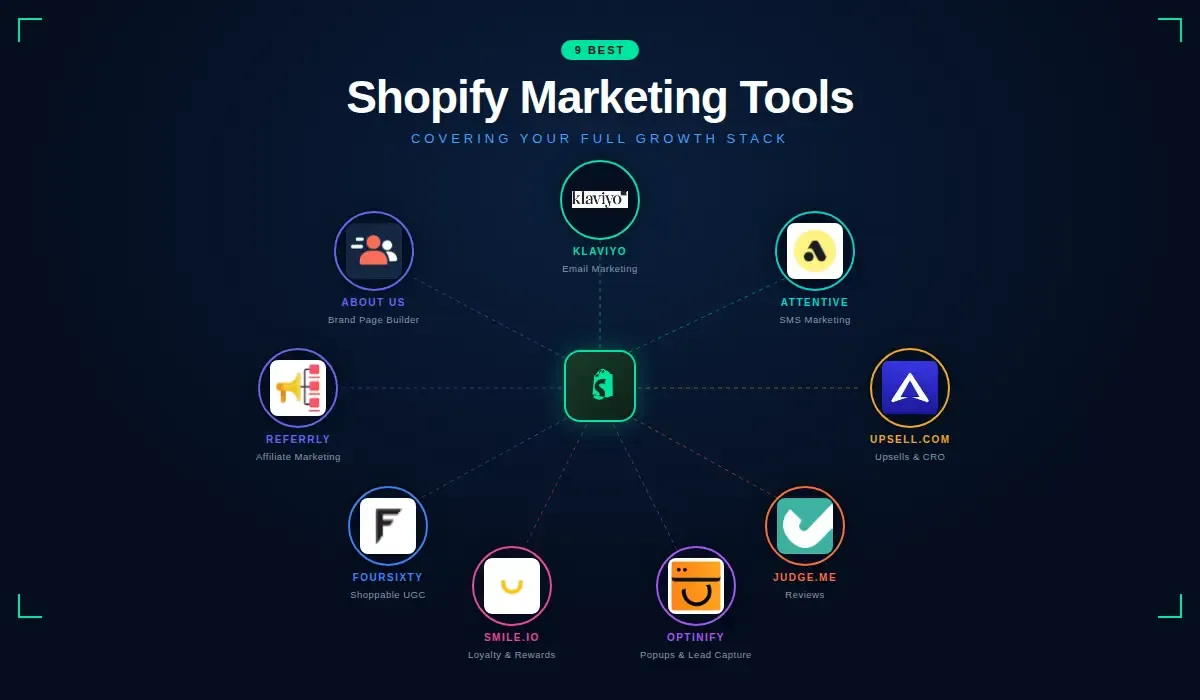
Are you paying lots of money for Shopify marketing tools? Please do not do so.
Shopify has a solid set of marketing tools built right into the platform.
The actual issue is which one you should use; you don’t know!
Each of the Shopify marketing tools does a single job. And they work together.
This guide covers 9 Shopify marketing tools that cover your full growth stack. From getting new customers to keeping the ones you have.
Quick look at what I'm covering (Shopify marketing tools)
9 best Shopify marketing tools
How I evaluate Shopify marketing tools before installing them
Before installing a Shopify marketing tool, I use this strict checklist:
- Native Integration: It must pull data directly from Shopify. I skip anything that requires manual imports.
- Revenue Analytics: It must track actual sales, not just clicks or impressions. If I cannot see the ROI, I do not keep it.
- True Automation: It must eliminate repetitive, manual tasks to save me time.
- Scalability: I want it to be scalable as my store grows three times in size so that I need to set it up only once.
- Stack Connectivity: It must integrate seamlessly with my existing tools. If it cannot talk to my email and SMS flows, it creates more work.
The 9 best Shopify marketing tools I actually use
1. Klaviyo (Email Marketing)
Klaviyo connects with your Shopify store and uses actual purchase data to send emails to your customers at the right time.
Best for:
- Welcome series for new subscribers
- Abandoned cart recovery
- Post-purchase follow-ups
- Win-back campaigns for customers I have not seen in a while
- Segmenting by purchase history so I am not sending the same email to everyone
2. Attentive (SMS Marketing)
With an outstanding 98% open rate, SMS marketing is leading the game.
Attentive is the winner in this game.
Best for:
- Flash sale alerts
- Cart recovery texts for people who didn't open the email
- Win-back messages
- new product drops for my top buyers
3. Upsell.com (Upsells and CRO)
Many Shopify stores lose out on extra sales because they leave the thank-you page unchanged.
The moment a customer finishes buying is actually your best chance to sell more. Because they already trust you.
Upsell.com lets you increase your revenue with one-click post-purchase upsells, in-cart offers, and checkout upsells. You do not need to spend more on ads to get these results.
Best for:
- Post-purchase one-click upsells
- Customizing the thank-you page with product recommendations
- Birthday collection
- Cross-sells based on what someone just bought
4. Judge.me (Reviews)
Reviews influence 93% of consumers' purchasing decisions.
When I look at my own buying behavior, I do the same thing. I check reviews before I buy almost anything.
Judge.me is the one I recommend to everyone.
Best for:
- Automated post-purchase review requests
- Displaying star ratings on product pages
- Collecting photo reviews from happy customers
- Google Shopping review syndication
- A Q&A section so customers can answer each other's questions
5. Optinify (Popups and Lead Capture)
Your email and SMS campaigns only succeed when people sign up.
Optinify is a Shopify popup app that helps you catch visitors as they are about to leave by using exit intent.
When someone moves to close the tab, a popup appears.
Best for:
- Exit intent popups on product and cart pages
- A/B testing.
- Email and SMS list building
- Different offers on different pages (10% off on product pages, free shipping on the cart page)
- Mobile-specific popups that look good on a phone
- Sending new subscribers directly into email marketing autoresponders
- Many popup options, including Lightbox, Full Page, and Floating Bar popups
6. Smile.io (Loyalty and Referrals)
It’s five to seven times cheaper to keep a customer than to find a new one.
Smile.io helps you keep customers coming back by offering points, VIP tiers, and a referral program.
You can connect Smile.io to your email marketing tools to automatically send messages when a customer is close to earning a reward or hasn’t engaged in a while.
Best for:
- Points program for purchases
- VIP tiers for my top spenders
- Referral campaigns
- Connecting to email marketing autoresponders for loyalty-based email flows
7. Foursixty (Shoppable UGC)
Your customers are already sharing posts about your products.
Foursixty helps you turn those posts into shoppable galleries on Instagram and TikTok.
79% of people say user-generated content has a big impact on what they buy. Each influencer gets a personal page, so you can see exactly what results they bring.
Best for:
- Shoppable Instagram and TikTok galleries on homepage
- Product page UGC sections
- Influencer shop pages
- Revenue tracking per piece of content
8. ReferrLy (Affiliate Marketing)
ReferrLy works inside your Shopify admin.
Just give your affiliates a tracking link and a discount code. ReferrLy takes care of everything else.
Affiliate marketing drives 16% of sales of all online sales.
Best for:
- Recruiting and managing affiliates from Shopify admin
- Giving each affiliate their own discount code and tracking link
- Automating commission payouts
- Identifying which affiliates actually drive revenue
9. Team and About Us (Brand Page Builder)
The About Us page is usually the second most visited page on your store.
Shoppers want to know who they are buying from. With this app, you can create your About Us page in just a few minutes.
Best for:
- Team member cards with photos, names, and roles
- Brand story section with images and videos
- Customizable layouts using premade templates
- Drag & Drop feature
- Building the page without touching any code
How I would build this stack starting from scratch

I would start with Optinify. Without a list or an audience, nothing else matters. Building that comes first.
Once subscribers are coming, I would set up Klaviyo and Attentive. Set up welcome flows, abandoned cart messages, and post-purchase emails. Get those running and let them work.
Next, I would add Judge.me. Each order should automatically request a review. More reviews help new customers feel confident about buying.
After that, I would use Upsell.com. When someone makes a purchase, it is the perfect time to offer them another product.
When orders start repeating, I would add Smile.io. This gives customers a reason to return and invite others to shop with you.
Once your customers are happy, I would add Foursixty. If people are already posting about your brand, you can turn those posts into shoppable galleries that often convert better than ads.
I would never skip the About Us page. It is usually the second most visited page on a site. People want to know who they are buying from before they make a purchase.
That is the approach I would take.
5 Common Mistakes
1. Ignoring lead capture
Don’t spend money on email or SMS platforms until you have a list of contacts.
Make sure to add a signup popup as soon as you launch.
2. Adding Shopify Marketing Tools without any strategy
High open rates don’t matter if your sales aren’t growing.
Figure out which channels actually bring in profits before you add more tools.
Right Shopify marketing tools can lead you to revenue.
3. Not Testing Before Implementation
When you are automating any task, test that.
Otherwise, wrong results will be delivered.
4. Skipping A/B Testing
Each time you run a test, your store improves a bit.
No matter if it’s a popup, an email, or a product page, make sure every tool you use offers A/B testing.
5. Treating Retention as an afterthought
Many businesses focus too much on finding new customers and forget about the ones they already have.
Keeping repeat buyers is cheaper, and they usually spend more over time.
Start building loyalty programs, collecting reviews, and setting up post-purchase processes right away.
FAQ on Shopify Marketing Tools
One last thing
The best stack is not the largest. It is the one where each tool has a clear job, and you can easily see what results it produces.
Start by making a list. Set up your workflows. Add social proof next. As your needs grow, add other tools one at a time.
If you have not set up lead capture yet, do that first. This is the key part that makes the rest of your stack more effective.
Install Optinify now and see what it does to your subscriber numbers.