

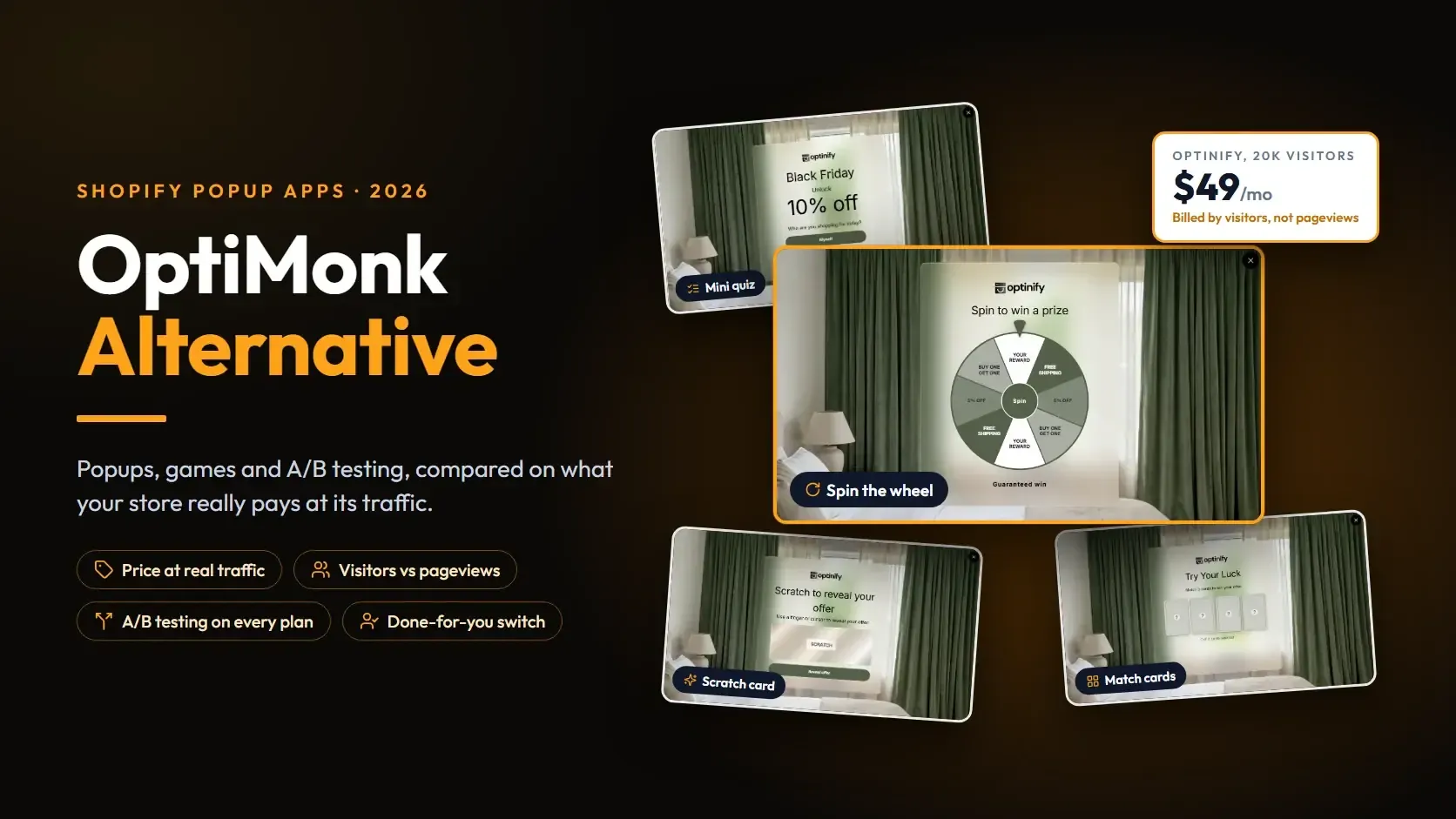
OptiMonk is a strong popup tool. It includes every feature on every plan, and has a capable AI agent. So if you are looking for an OptiMonk alternative, the reason is usually fit: it bills on every pageview, and some stores would rather pay by visitors. This guide shows what 10 Shopify popup apps cost at your traffic.
Our verdict up front: for most Shopify stores with 10,000 to 40,000 monthly visitors, Optinify is the best OptiMonk alternative. You get similar popup formats, games and A/B testing, you pay by visitors instead of pageviews, and at 20,000 visitors that's $49 a month against $99.
One honest warning: OptiMonk is cheaper at some traffic levels, including anything under about 10,000 visitors. The table below shows exactly where.
Prices and ratings come from each app's Shopify App Store listing, checked on October 30, 2026. Where a listing doesn't show a plan, we use the vendor's website and say so.
Which OptiMonk Alternative Fits Your Store?
Most marketers exploring alternatives start with price, but the right replacement depends on your traffic, your email platform and what's actually bothering you about OptiMonk. Stores in the 10K to 40K visitor range should start with Optinify. Everyone else can use this table to find a shortlist of one or two.
Which OptiMonk Alternative Fits Your Store?
Why Do Merchants Look for an OptiMonk Alternative?
Most merchants look elsewhere because of how the pricing fits their store, not because of the product. OptiMonk charges by total pageviews, so the bill follows how much shoppers browse. Features rarely come into it, since every plan includes all of them.
Here's where the fit can change, based on OptiMonk's pricing page and its Shopify reviews:
- Billing follows pageviews. A shopper browsing eight products uses eight pageviews, whether a popup shows or not, so a store with heavy browsing moves up plans sooner.
- Plan steps can be large. The website's Essential plan stops at 50,000 pageviews, and the next step up is $99. A store around 17,000 visitors can move from $59 to $99 with one good month.
- Campaigns pause at the limit. OptiMonk emails you at 80%. At 100%, popups stop until you upgrade or the counter resets, so check your limit before a big sale.
- Domains vary by plan. You get 1, 2, 4 or 10 domains, and subdomains count separately. This mostly matters to agencies, and Optinify won't solve it, since we price per store.
- Setup can take some learning. A few reviewers mention a learning curve, which is common for a tool this broad.
OptiMonk Pricing in 2026
Before you explore OptiMonk alternatives in detail, it helps to know what you'd pay now, because any OptiMonk alternative has to beat this ladder. The plans are simple on the surface, but each one hides a dropdown of pageview steps. The Shopify listing shows each plan's starting step ($29, $99 and $249). The other steps come from OptiMonk's website, so here's the full ladder:
OptiMonk Pricing in 2026
Yearly billing saves 25%, which brings the starting prices down to $19, $69 and $179, paid upfront. AI credits also rise with each step, from 1,000 on Free to 30,000 at the top of Premium. If you lean on the AI agent, check that number too.
How Does Each OptiMonk Alternative Compare?
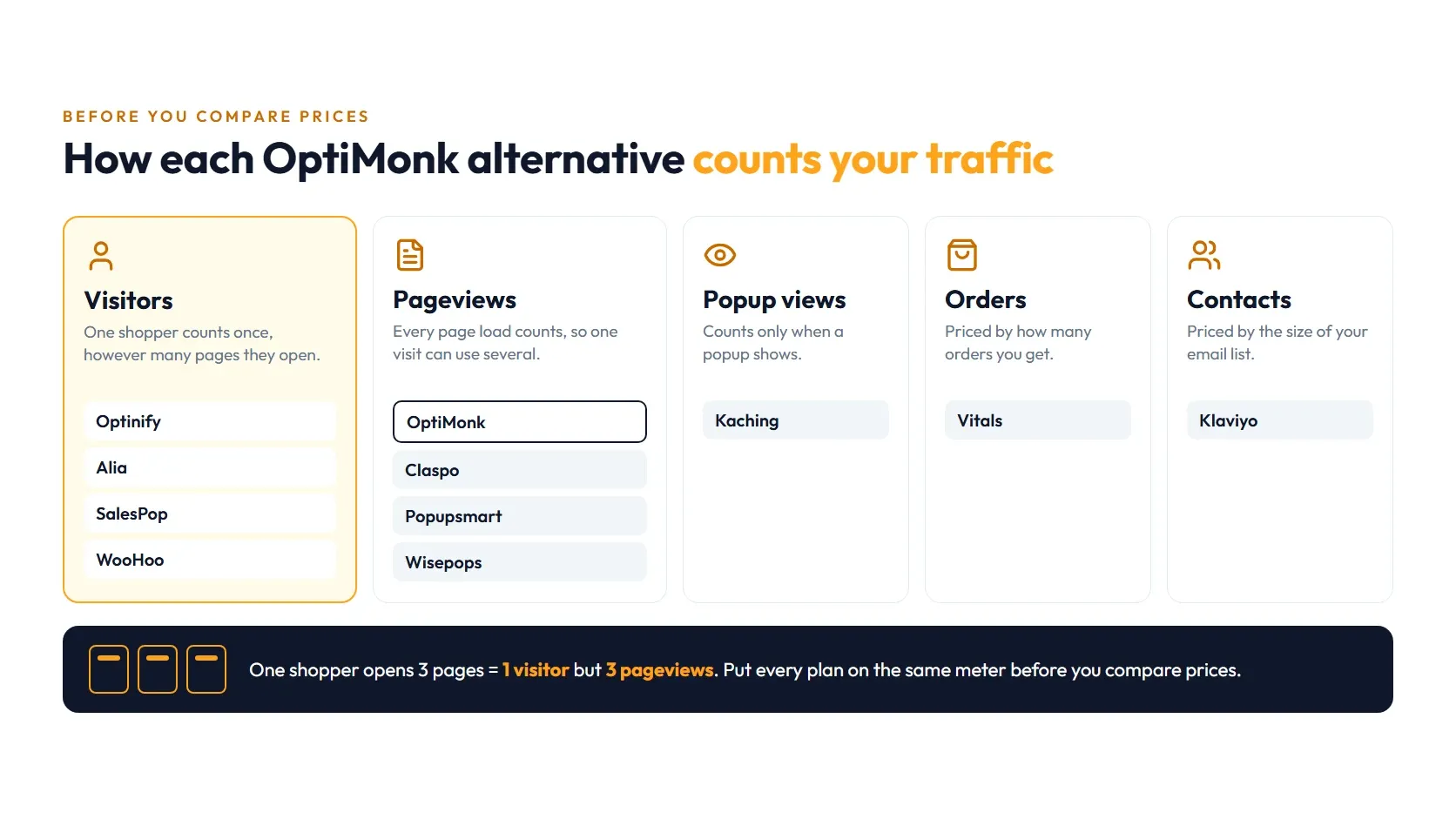
Here are the entry plans side by side, with OptiMonk on top for reference. Watch the "entry plan covers" column, because what an app counts changes the real price more than the headline number does.
How Does Each OptiMonk Alternative Compare?
*Klaviyo's rating covers its whole email and SMS app, not just forms. Prices are monthly billing in USD from each Shopify listing. Annual billing is cheaper for most of them.
What You'd Pay at 20,000 Visitors a Month
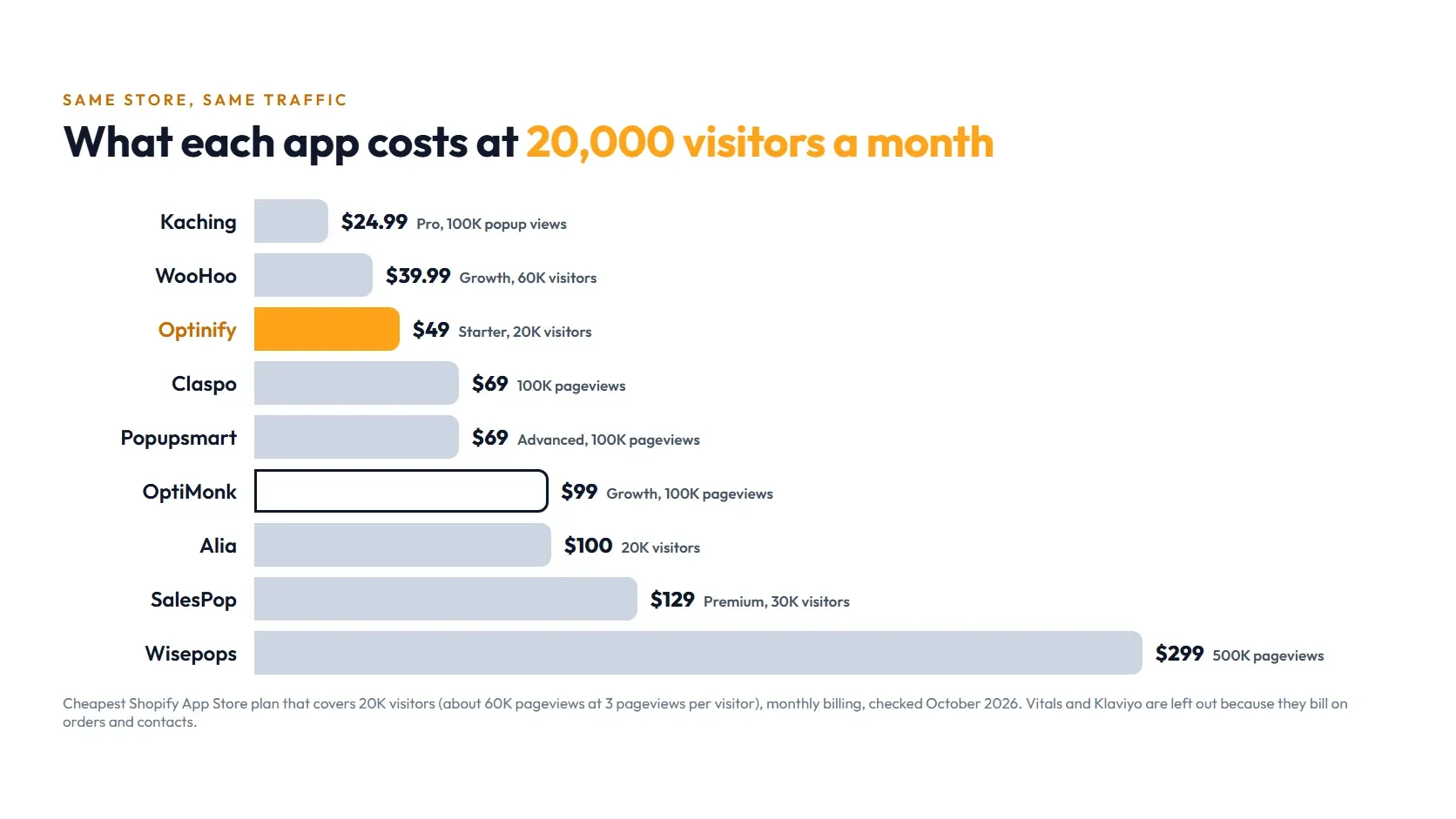
Entry prices hide the real cost. "50K pageviews" sounds bigger than "20K visitors", but it's smaller, because one visitor usually opens several pages. We assumed three pageviews per visitor, a ratio some popup vendors use on their own pricing pages. Your store's real number is in Shopify analytics.
For 20,000 monthly visitors (about 60,000 pageviews), the cheapest plan that covers you costs:
What You'd Pay at 20,000 Visitors a Month
Two apps don't fit this table. Vitals bills on orders, so a store with up to 200 orders a month pays $29.99, and one with 201 to 1,000 pays $79. Klaviyo bills on contacts, with forms bundled in.
Kaching and WooHoo cost less than Optinify here, and they're worth a look on a tight budget. They aren't quite like-for-like, though: Kaching is built around upsell offers, and WooHoo's top listed plan stops at 60,000 visitors.
OptiMonk vs Optinify at Every Traffic Level
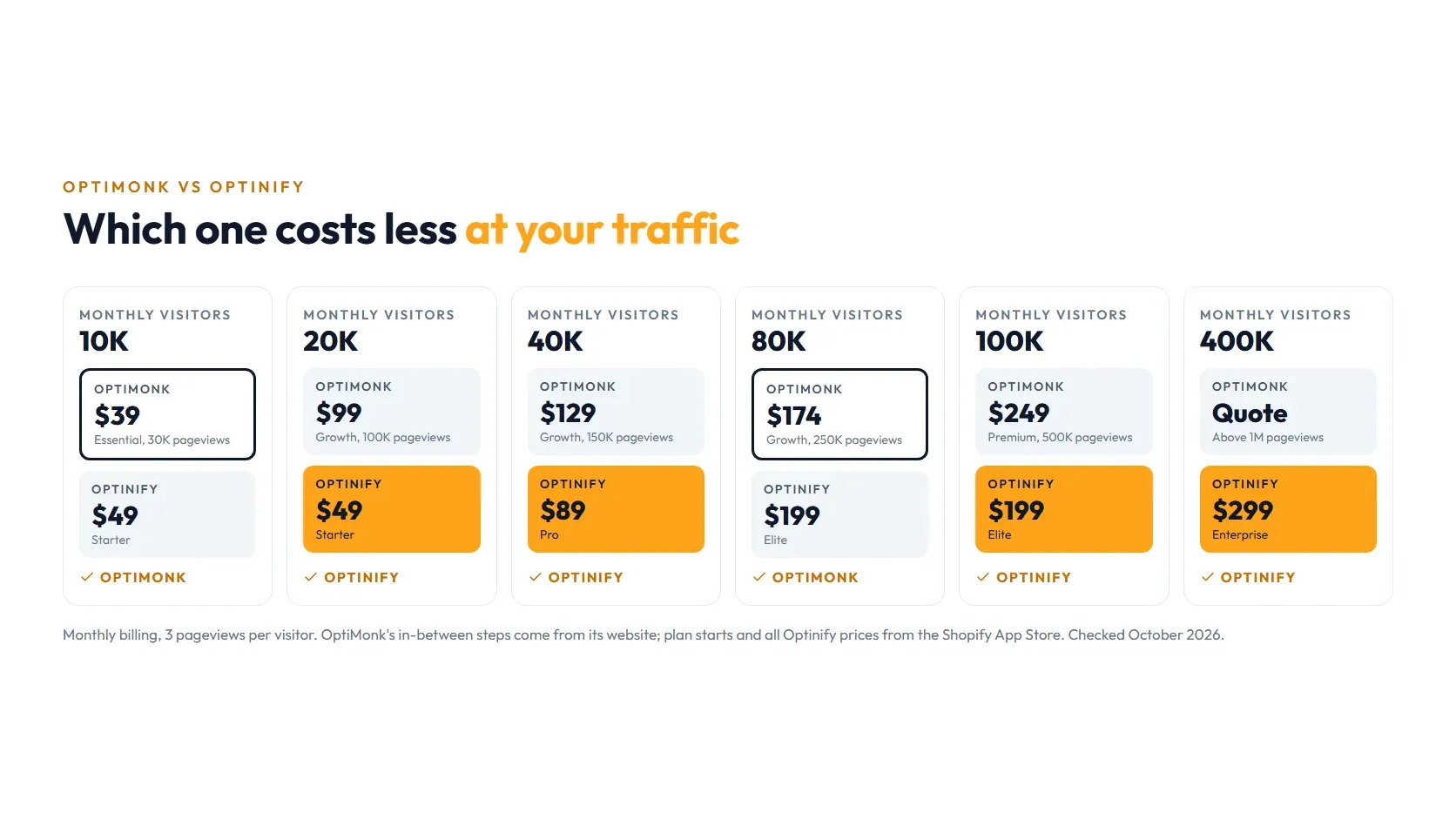
If you're choosing between the two, this is the table that matters, and it doesn't all go our way. Same three pageviews per visitor, monthly billing. OptiMonk's in-between steps here are its website prices, since the listing only shows each plan's start:
OptiMonk vs Optinify at Every Traffic Level
So it swings back and forth, because both products have steps in different places. The clearest win for Optinify is 15K to 40K visitors, where it saves $10 to $50 a month. On yearly billing the gap at 20K visitors is $470.40 against $828.
The ratio matters as well. If shoppers on your store open five pages rather than three, OptiMonk's column moves up and ours stays put. At 40,000 visitors that's $174 against $89.
The Best OptiMonk Alternative for Shopify: 10 Apps in Detail
Here are the 10 in detail, starting with our top pick. They don't all do the same job, so we've said plainly where one replaces OptiMonk and where it only covers part of it.
1. Optinify: The Best OptiMonk Alternative Overall
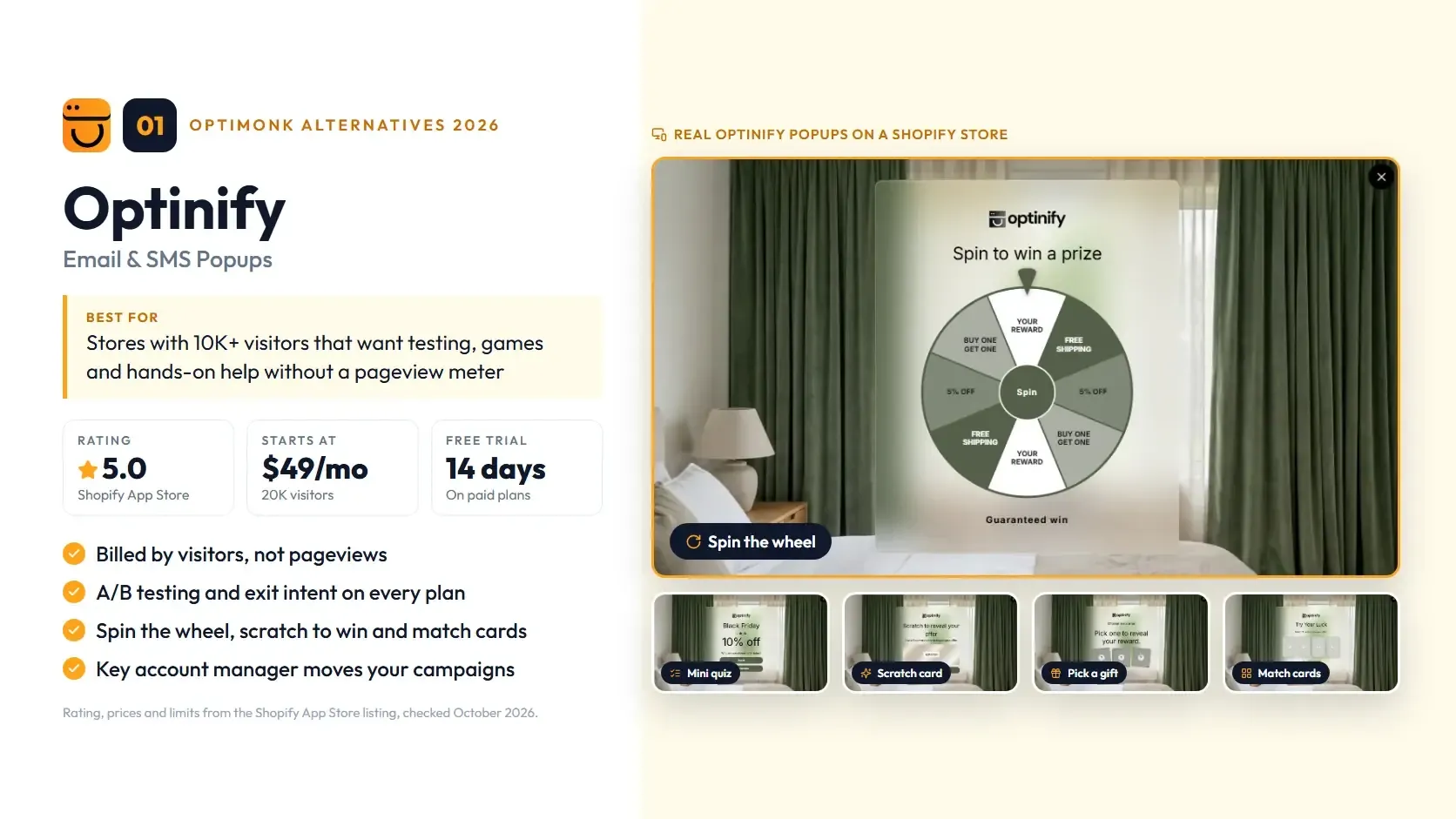
Best for: Shopify brands with 10,000 visitors or more that want testing, games and hands-on help without watching a pageview meter.
Optinify is a Shopify popup app for email and SMS capture. It's priced by monthly visitors, and every plan includes every feature:
- Popup formats: lightbox, floating bar and full-page popups, multi-step popups, plus announcement, free-shipping and countdown bars.
- Games and quizzes: spin the wheel, scratch to win, mystery discount, match cards and mini quiz popups. Our spin-to-win popup page shows how the wheel works.
- Triggers and advanced targeting options: exit-intent popups, scroll depth, time delay and idle triggers, plus new or returning visitors, device, country and Shopify Markets. Our guide to popup targeting rules shows how to combine them.
- Customization: a fully customizable canvas, plus ready-made templates across popup types.
- List growth and cart abandonment: discount popups that build your email lists, and exit-intent offers to reduce cart abandonment when a shopper is about to leave a full cart.
- Offers: unique discount codes and frequency capping, so shoppers don't see the same offer on every visit.
- Testing and timing: a built-in A/B test campaign on every plan, plus campaign scheduling with start and end dates.
- Reporting: in-depth analytics with a lead funnel and multiple reports.
- Integrations: Klaviyo, Mailchimp, Omnisend, Brevo, GoHighLevel, Drip, MailerLite, ActiveCampaign, Moosend, Redo and TargetBay, plus Shopify customers. Here's every tool Optinify connects to.
- Support: live chat and email from real people on every plan, concierge onboarding and translation into local languages.
Optinify Pricing and Trade-Offs
Pricing: Starter $49/mo (20K visitors), Pro $89/mo (40K), Elite $199/mo (100K) and Enterprise $299/mo (400K). Annual billing saves 20%. See Optinify pricing.
Compared to OptiMonk: At 20K visitors you pay $49 instead of $99, and browsing doesn't move your bill. A key account manager moves your OptiMonk campaigns over and publishes them for you.
Worth knowing: No free plan, no AI popup generator, and it won't run outside Shopify. Attentive and Postscript aren't on our integrations list, and OptiMonk has them. We've also got six Shopify reviews, all five stars. That's a small sample, so use the trial to judge it for yourself.
2. Kaching: For Upsell Popups on a Small Budget
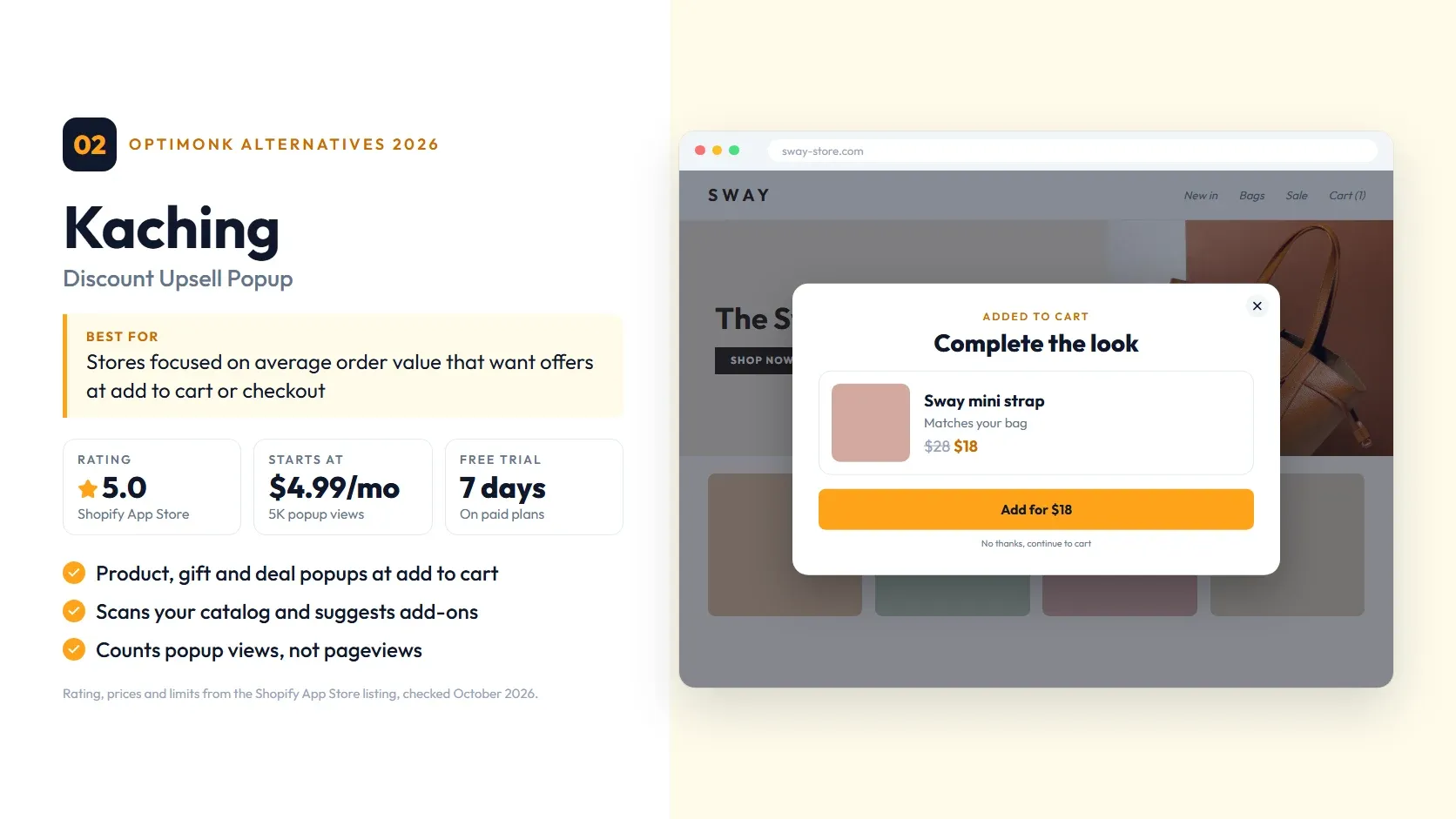
Best for: Stores focused on average order value that want product offers at add to cart or checkout.
Kaching Discount Upsell Popup comes at popups from the revenue side. It shows a product, slider, free gift or deal when someone adds to cart, starts checkout, scrolls or goes to leave. It scans your catalog on install and suggests add-ons, and A/B testing is built in.
Pricing: Starter $4.99/mo (5K popup views), Growth $12.99 (25K) and Pro $24.99 (100K). Free for development stores only. Paid plans have a 7-day trial.
Compared to OptiMonk: Far cheaper, and it counts popup views, not pageviews, so quiet pages cost nothing.
Worth knowing: It's an upsell tool first, not a full OptiMonk alternative. Its listing doesn't mention email capture or games, so if list growth is the point, confirm that before you install.
3. Wisepops: For Large Brands With Budget
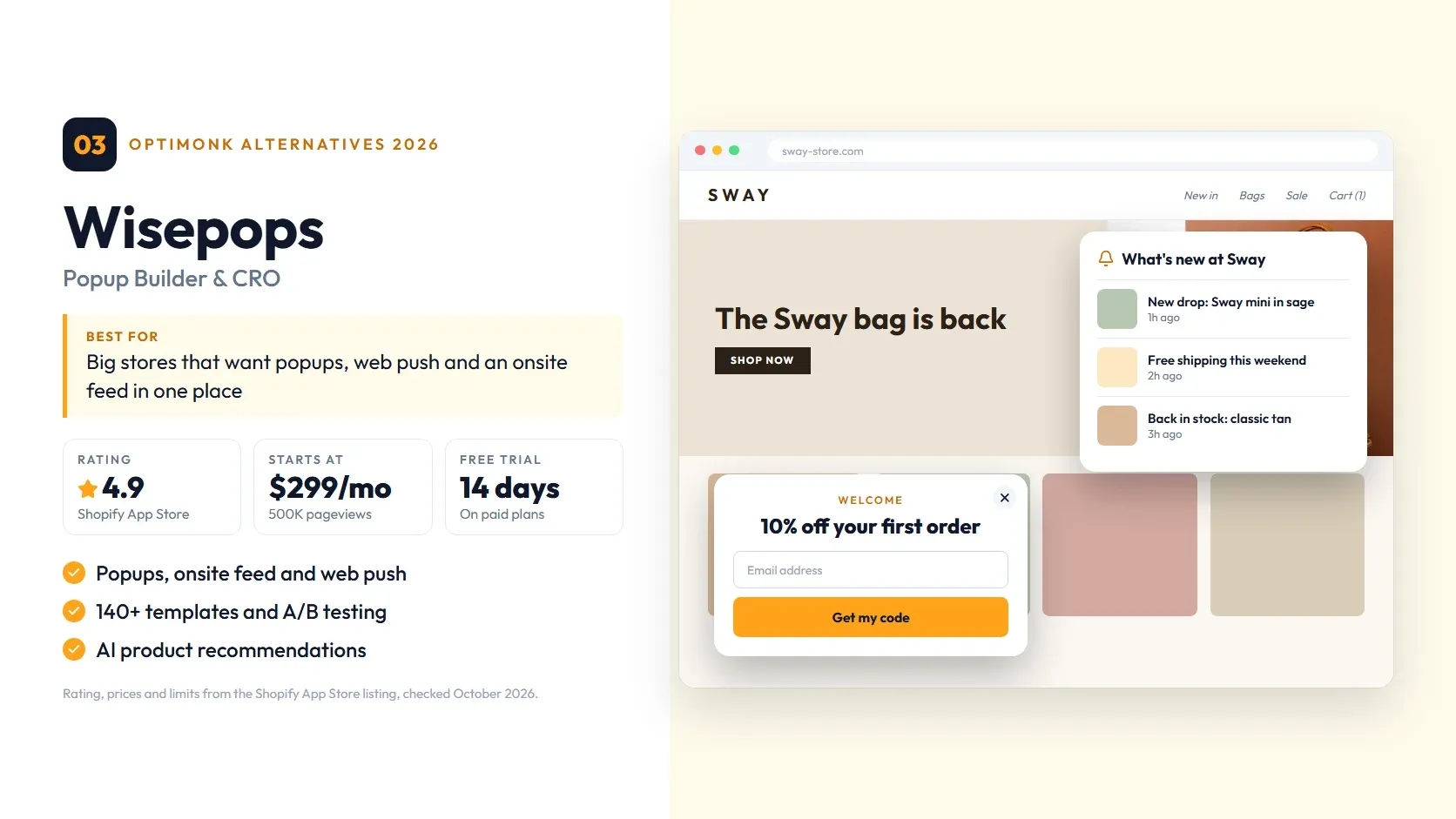
Best for: Big stores that want popups, web push and an onsite feed in one place.
Wisepops includes 140+ templates, AI product recommendations, web push and A/B testing, with a Klaviyo integration and a Shopify plan that's fully self-serve.
Pricing: The Shopify listing shows one plan: $299/mo or $2,990/yr, for up to 500K pageviews, with a 14-day trial. The website's pricing link leads to a demo booking, so other plans need a sales call.
Compared to OptiMonk: OptiMonk's 500K tier is $249. You'd pick Wisepops for the extra channels, not the price.
Worth knowing: The Shopify plan covers 500K pageviews at $299, so it suits larger stores best.
4. Vitals: For Replacing Several Apps at Once
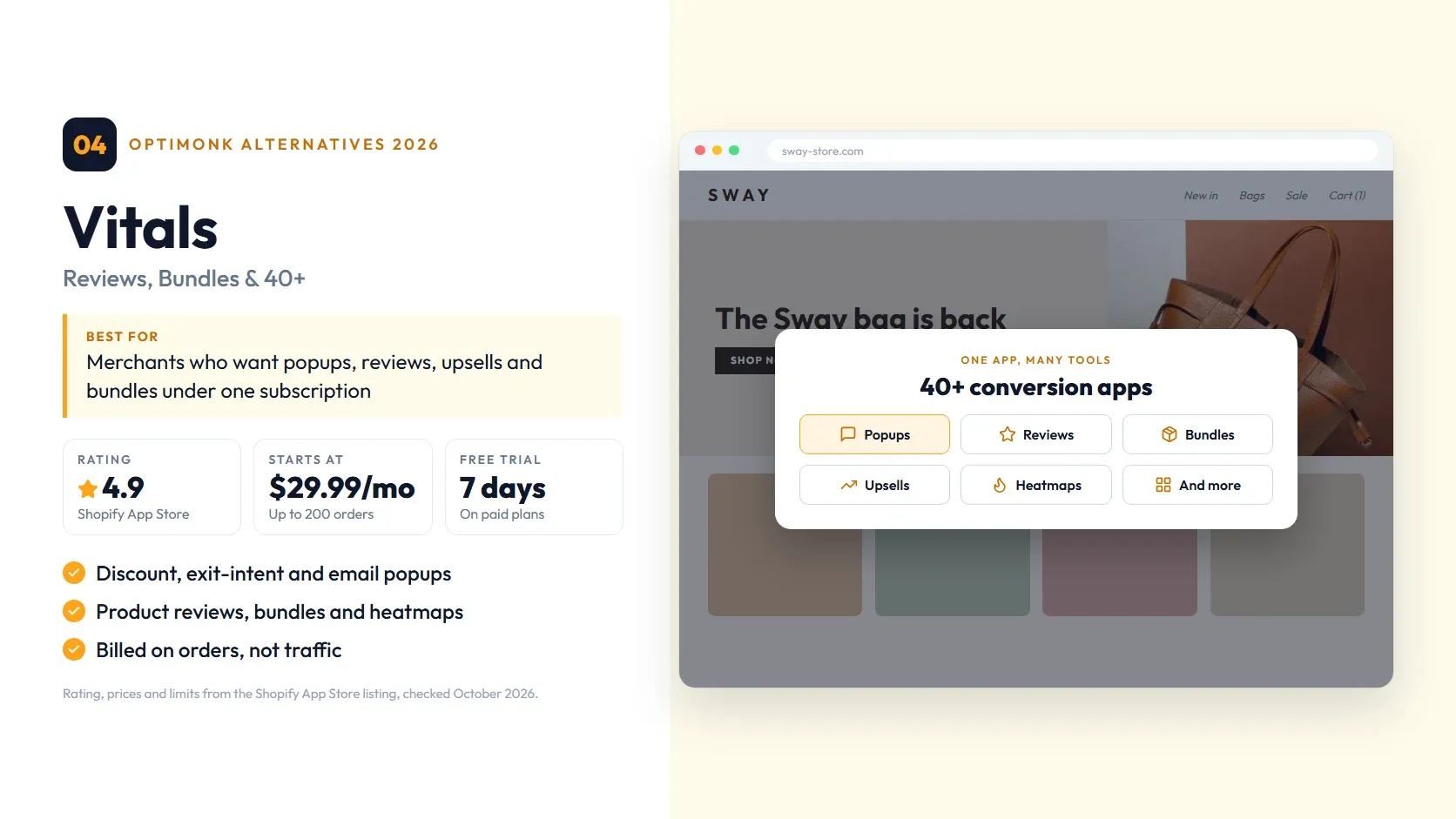
Best for: Merchants who want popups, reviews, upsells and bundles under one subscription.
Vitals packs 40+ conversion tools into one install, including discount, exit-intent and email-collection popups, plus product reviews, bundles and heatmaps. That last one helps if you want to see where visitors get stuck.
Pricing: Starter $29.99/mo (up to 200 orders), Growth $79 (201 to 1,000) and Pro $179 (1,001 to 5,000). Each has a 7-day trial. Free for development stores only.
Compared to OptiMonk: You pay on orders, not traffic, so a busy store with few sales pays little. A store with many sales pays more.
Worth knowing: Popups are one part of a big toolbox. If popups are your main channel, expect less depth than from a specialist.
5. Alia: For AI-Run Testing on a Bigger Budget
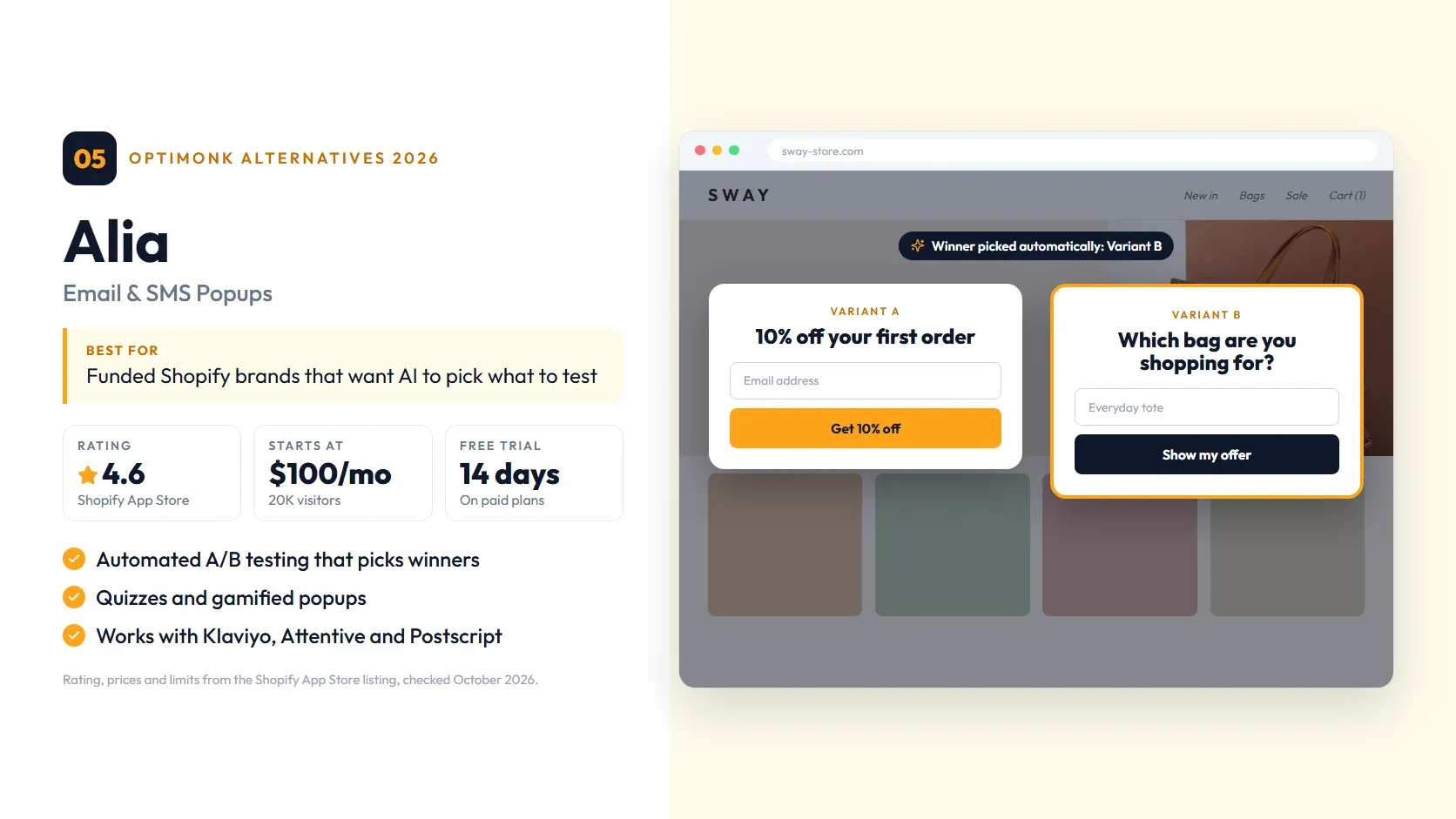
Best for: Funded Shopify brands that want AI to pick what to test.
Alia is a Shopify app for email and SMS capture, with real-time personalization, automated A/B testing, quizzes and gamified popups. It connects to Klaviyo, Attentive, Postscript, Omnisend, Sendlane and Yotpo, which helps if your SMS runs on Attentive or Postscript.
Pricing: $100/mo (20K visitors), $200 (50K), $300 (100K) and $400 (300K), with a 14-day trial.
Compared to OptiMonk: Visitor billing, and about the same price at 20K. After that it costs more: $200 against $129 at 50K visitors.
Worth knowing: The $100 entry price suits brands with a budget for automated testing.
6. Claspo: For Pageview Pricing Without the Jump
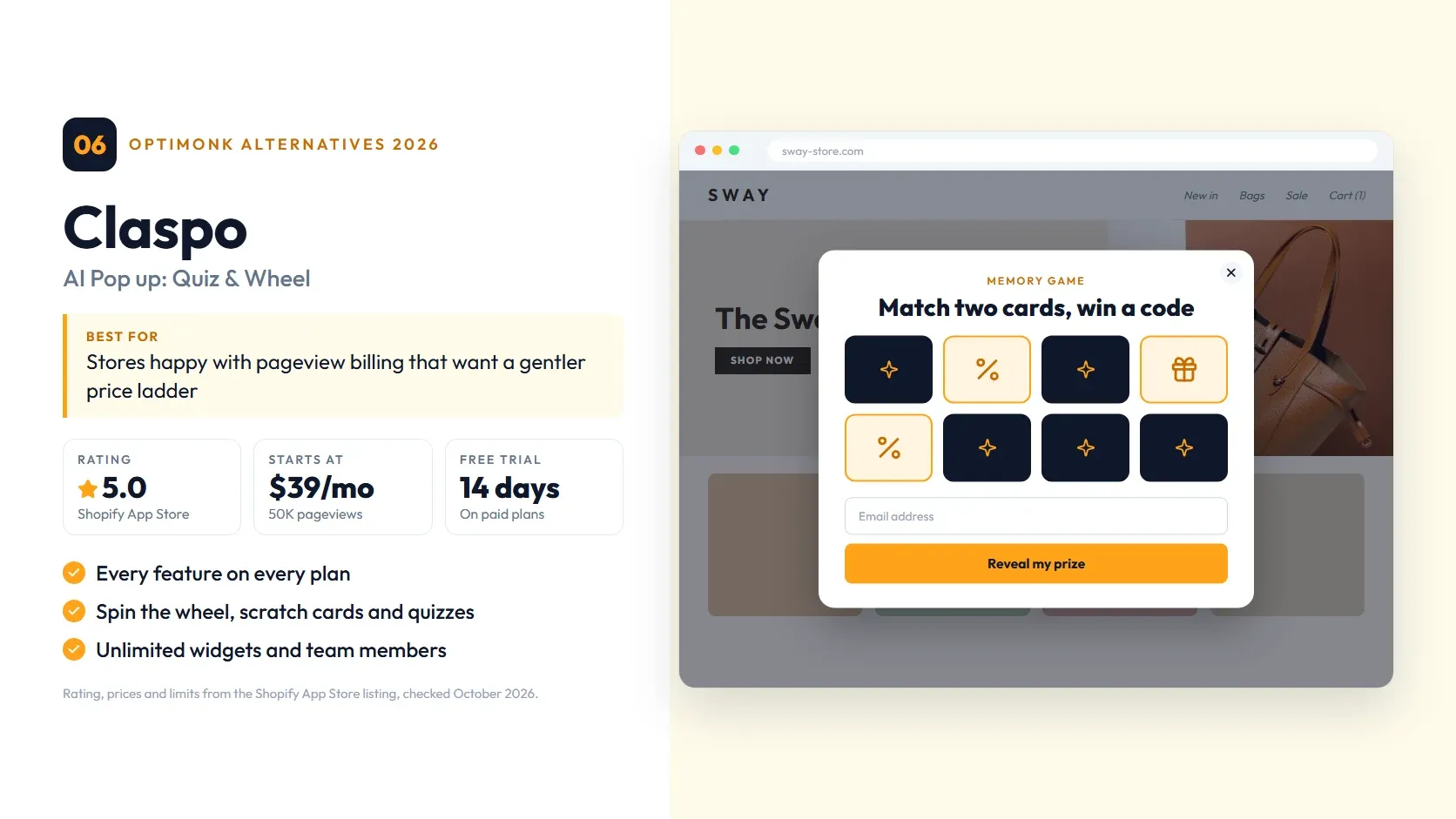
Best for: Stores happy with pageview billing that want a gentler ladder.
Claspo includes every feature on every plan, with unlimited widgets and team members, spin the wheel, scratch cards, product quizzes and A/B testing.
Pricing: Free for 3K pageviews with a "Powered by Claspo" badge. On Shopify: $39/mo (50K pageviews), $69 (100K) and $249 (1M). Check the pricing page.
Compared to OptiMonk: $69 against $99 at 100K pageviews, and $249 against $374 at 1M. It's the closest like-for-like OptiMonk alternative on this list.
Worth knowing: Billing is by pageviews, the same as OptiMonk.
7. Klaviyo: Free If You Already Use It
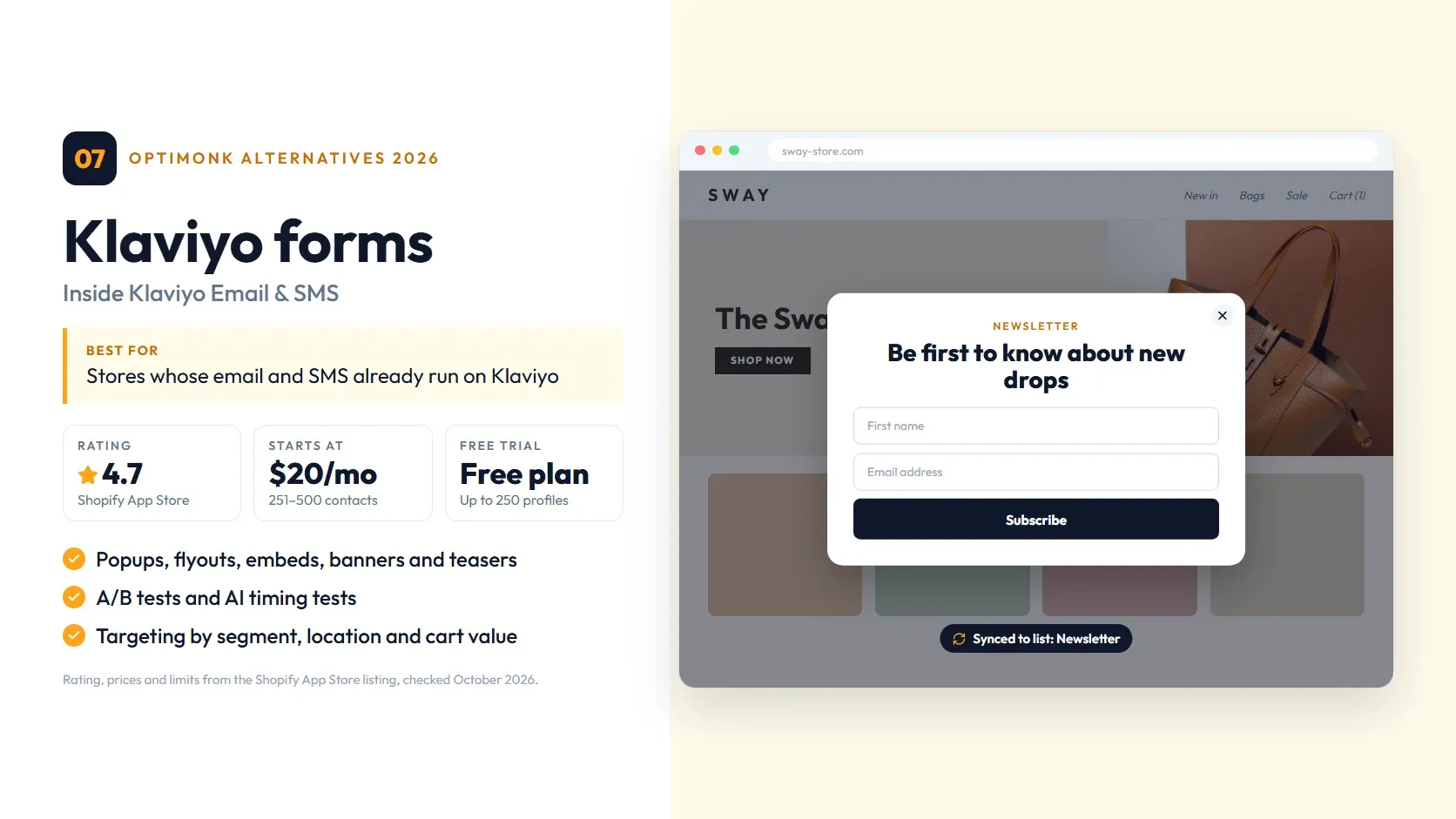
Best for: Stores whose email and SMS already run on Klaviyo and who want simple signup forms without another app.
Forms come with the Klaviyo app. According to its forms page, you get popups, flyouts, embedded and full-page forms, banners and teasers, with A/B testing, AI timing tests and targeting by segment, location and cart value.
Pricing: Free up to 250 active profiles. Email starts at $20/mo for 251 to 500 contacts, and SMS from $15/mo for 1,250 credits.
Compared to OptiMonk: No traffic meter at all, and forms and flows share one audience. Your bill follows your list, not your visitors.
Worth knowing: It works best when Klaviyo is your email platform, and spin-to-win is the only game its forms page names.
8. Popupsmart: For AI Drafts and Middle Tiers
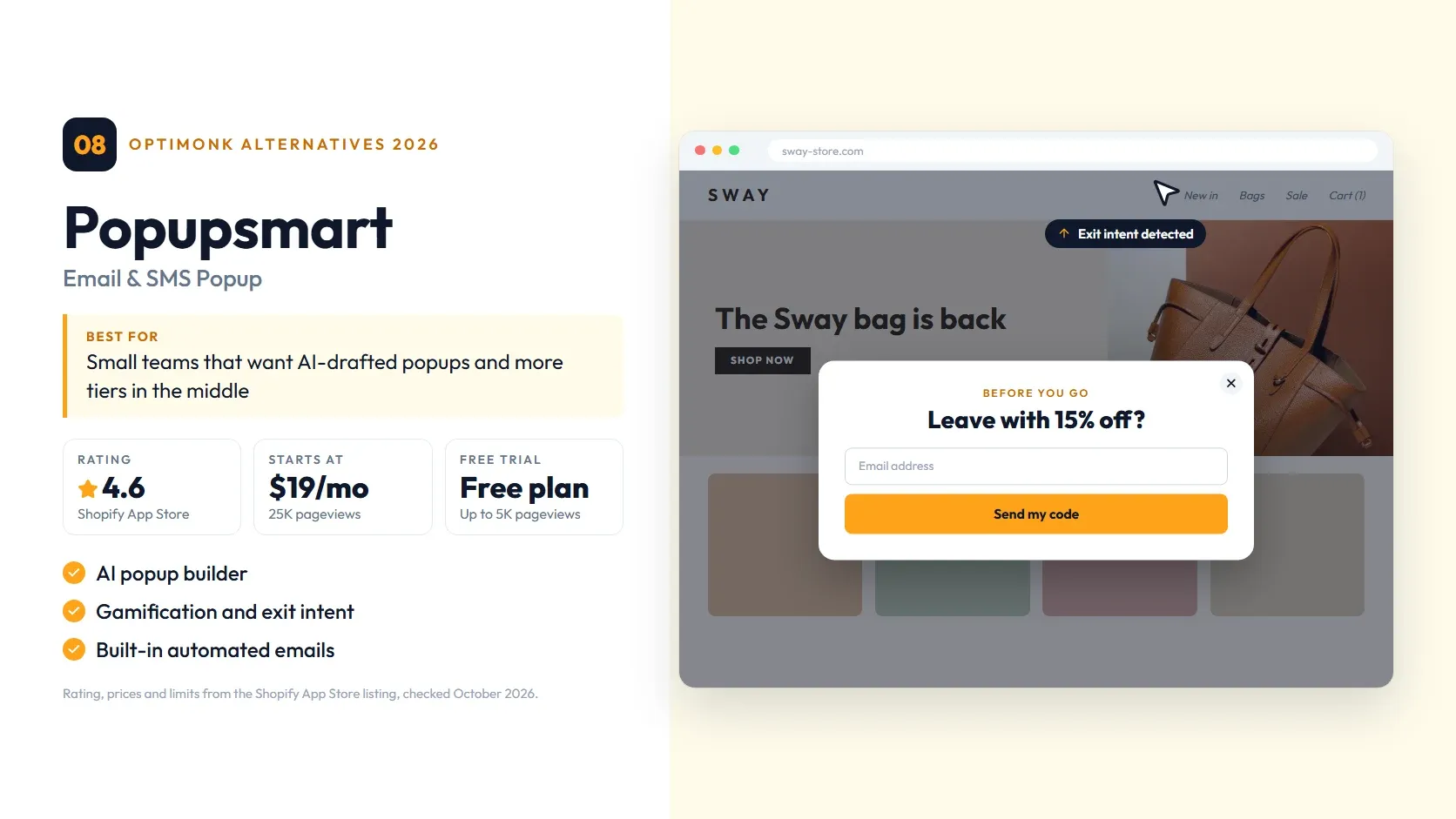
Best for: Small teams that want AI-generated popups and more choice between 20K and 250K pageviews.
Popupsmart has an AI popup builder, gamification, exit intent and built-in automated emails.
Pricing: Free for 5K pageviews and one live popup. On Shopify: Starter $19/mo (25K), Basic $39 (50K) and Advanced $69 (100K). Its website adds Pro $99 (250K) and Expert $159 (500K).
Compared to OptiMonk: Cheaper at every pageview step we checked, and $99 buys 250K instead of 100K.
Worth knowing: A/B testing starts at $69, while OptiMonk includes it free. It's also metered on pageviews.
9. SalesPop: For Social Proof Alongside Your Popups
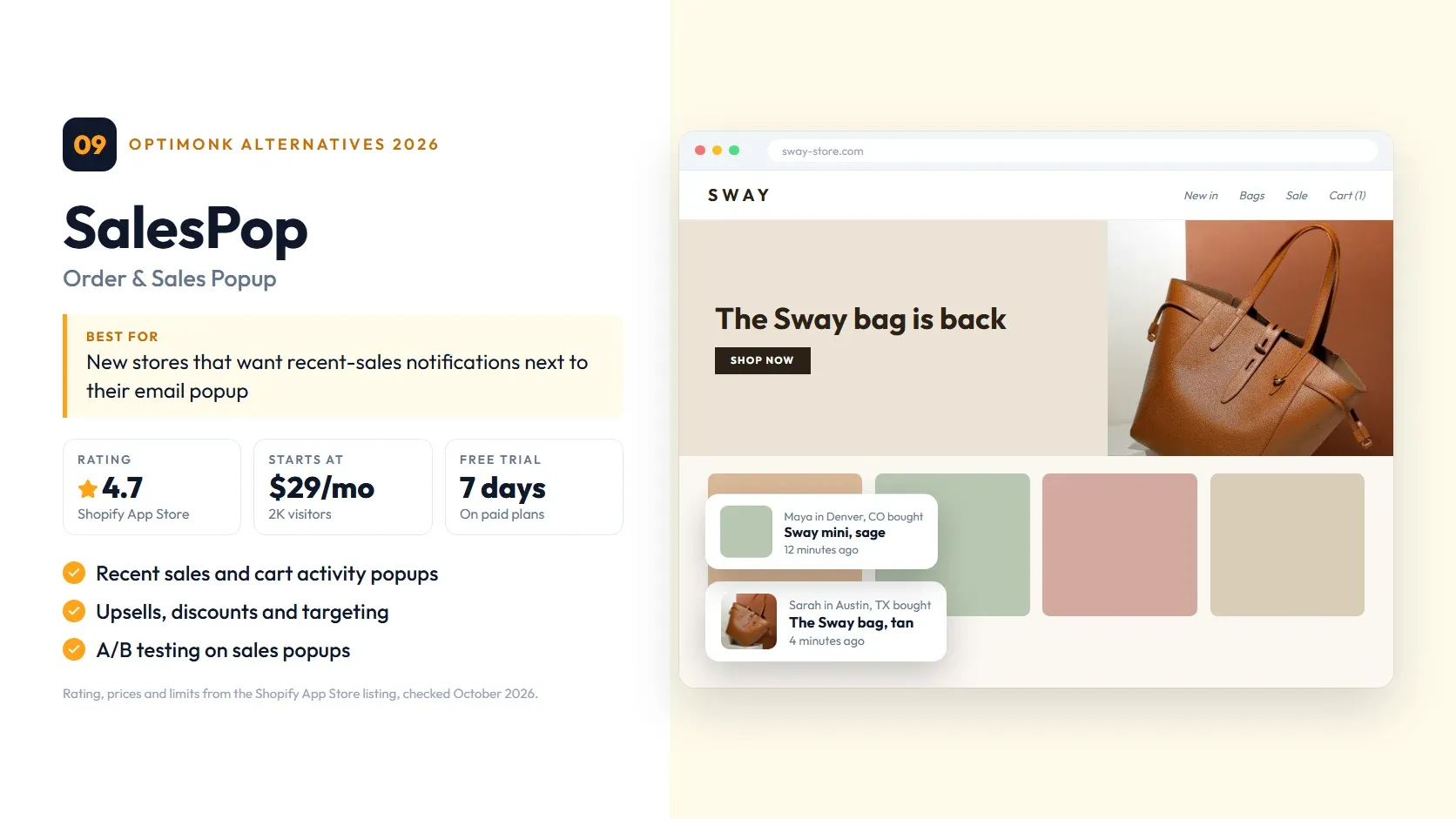
Best for: New stores that want recent-sales notifications to build trust.
SalesPop shows recent sales and cart activity, with upsells, discounts, targeting and A/B testing. It's a companion to an email popup more than a replacement: its listing doesn't mention email capture.
Pricing: Free for 200 visitors. Starter $29/mo (2K visitors), Pro $79 (10K) and Premium $129 (30K), with a 7-day trial.
Compared to OptiMonk: A different job, so it isn't a true OptiMonk alternative. Pair it with a capture tool, don't swap one for the other.
Worth knowing: Plans are built around smaller traffic levels, and the listing mentions usage-based charges, so check your billing settings as you grow.
10. WooHoo: For Low-Cost Games on a Small Store
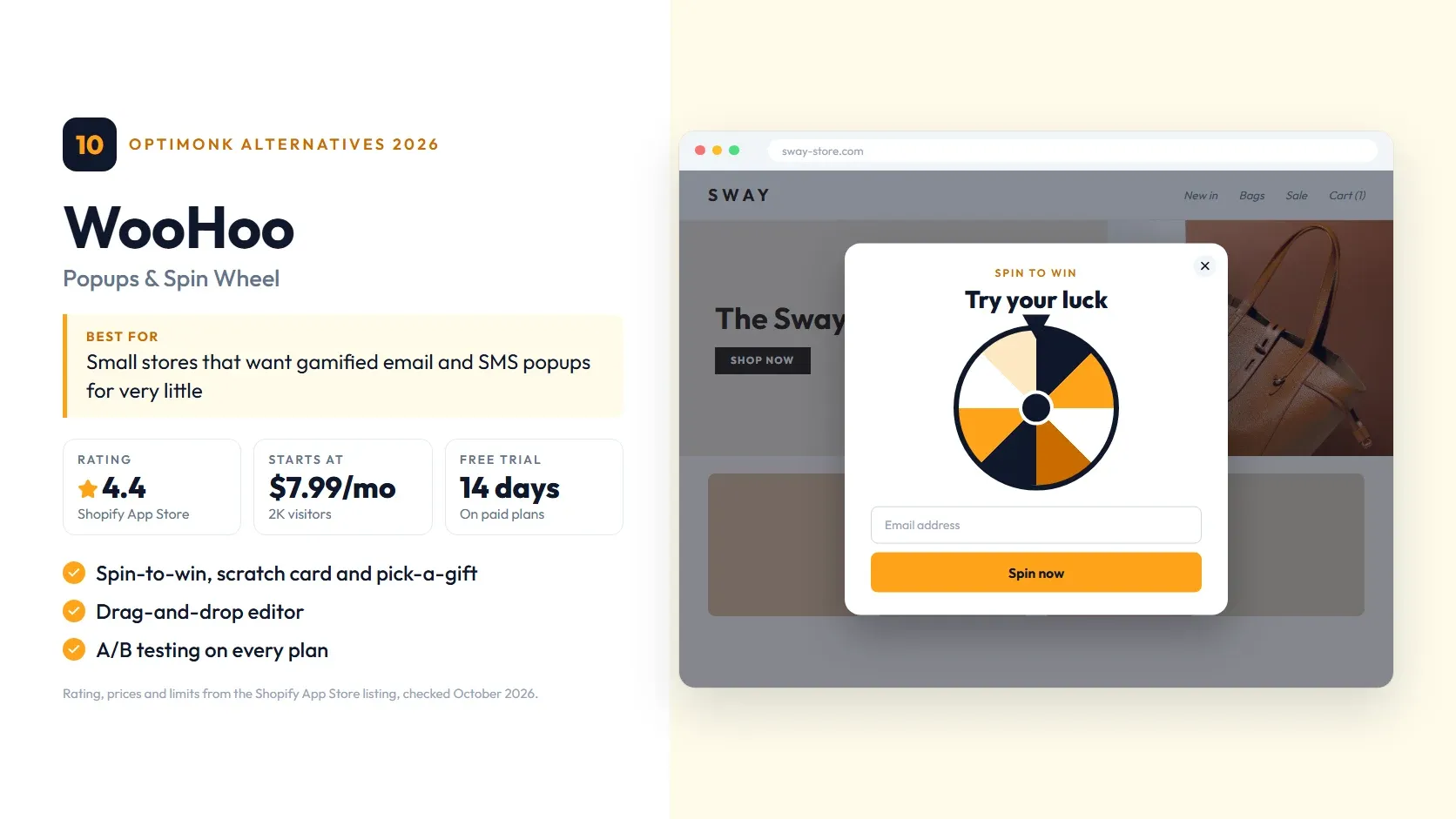
Best for: Small stores that want gamified email and SMS popups for very little money.
WooHoo offers spin-to-win, scratch card and pick-a-gift games with a drag-and-drop editor. All plans include unlimited campaigns, targeting, A/B testing and analytics.
Pricing: Free for 500 visitors. Basic $7.99/mo (2K), Starter $14.99 (10K) and Growth $39.99 (60K), with a 14-day trial.
Compared to OptiMonk: Visitor billing at a fraction of the price. At 20K visitors it's $39.99 against $99.
Worth knowing: It rates 4.4 from 195 reviews, and the top listed plan covers 60K visitors, so larger stores should ask about higher tiers.
Situational Picks Worth Knowing
Four of these apps aren't a complete OptiMonk alternative, and they make the most sense if you already know what you want. Here's when each is the right call, and what to keep in mind.
Situational Picks Worth Knowing
The Best OptiMonk Alternative by Store Size
Budget and traffic narrow this list faster than features do, so the best popup app for you depends on where your store sits today.
The Best OptiMonk Alternative by Store Size
Optinify Pro Tip
If you want a wider look, see our roundup of the best Shopify popup apps.
What About an OptiMonk Alternative for WordPress?
Optinify is Shopify-only, and several other apps here are built for Shopify too. Two clearly work beyond it: Claspo has a WordPress plugin and a script for custom sites, and Popupsmart installs on WordPress with an embed code. Wisepops also installs on custom sites with one script tag.
Is There a Free OptiMonk Alternative?
Yes, but OptiMonk's own free plan is hard to beat. It gives you 10,000 pageviews, every feature and no branding, with no credit card required. Popupsmart offers 5,000 pageviews with one live popup, and Claspo 3,000 with a badge.
WooHoo covers 500 visitors, SalesPop 200, and Klaviyo includes forms up to 250 active profiles. If you're leaving OptiMonk just to avoid paying, you may be moving to something smaller. A trial is a better test: Optinify, Alia, Wisepops, Claspo and WooHoo all offer 14 days.
OptiMonk vs OptinMonster: Which One Should You Pick?
For most Shopify stores, we'd pick OptiMonk, which has a free plan and more Shopify reviews. OptinMonster is a good fit for publishers, with a long WordPress history and billing on popup impressions instead of pageviews. It's a fair OptiMonk alternative for content sites, and we left it off this Shopify list because it's strongest outside Shopify.
OptiMonk vs OptinMonster: Which One Should You Pick?
OptiMonk vs Other Personalization Platforms
OptiMonk is sometimes compared with full personalization suites, and that's usually the wrong comparison. They solve a bigger problem at a bigger budget.
OptiMonk vs Other Personalization Platforms
Is Google Optimize Still an OptiMonk Alternative?
No. Google shut down Optimize on September 30, 2023, and it was never really a substitute. Optimize ran page experiments. It wasn't a popup tool or a landing page builder, while OptiMonk builds and targets popups to capture leads. Any list still recommending it is out of date.
If page-level testing is what you're after, look at dedicated tools like VWO or Optimizely. For testing the popups themselves, see our A/B testing strategies for popups.
OptiMonk Pros and Cons
Pros:
- A free plan with every feature and no branding
- No feature gates between plans, including A/B testing and exit intent
- An AI agent that builds campaigns, plus a connection to Claude, ChatGPT and Cursor
- Product recommendations and deep Shopify targeting, such as customer tags and cart value
- Strong Shopify reviews at 4.8 from 453, plus Attentive and Postscript integrations
- It also runs on WooCommerce, BigCommerce, Wix and custom sites
Cons:
- Every pageview counts, including those without a popup
- A step from $59 to $99 between 50K and 100K pageviews
- Campaigns pause at the limit until you upgrade or the counter resets
When Does It Make Sense to Stay With OptiMonk?
Stay if you use OptiMonk for Shopify with under about 10,000 monthly visitors, you use the AI agent a lot, or you rely on product recommendations and Attentive or Postscript. Also stay if your traffic sits around 50K to 80K visitors, where OptiMonk beats us on price.
If "why don't visitors convert?" is your only complaint, you may not need an OptiMonk alternative at all. Microsoft Clarity is free and adds heatmaps and session recordings next to whatever popup tool you run.
Optinify vs OptiMonk at a Glance
Optinify vs OptiMonk at a Glance
Optinify wins for a growing store on Shopify that wants a bill it can predict and someone to do the migration. OptiMonk keeps its edge for small stores, AI-led campaign building and sites off Shopify.
What to Check Before Choosing an OptiMonk Alternative
A few questions will save you a bad surprise in month two:
- How does it count traffic? Pageviews, visitors, popup views, orders and contacts all behave differently. Convert each to your own numbers.
- What happens at the limit? OptiMonk pauses campaigns, and other apps handle it differently. Not every app publishes its rule, so ask each one, including us.
- Is the integration native? Check for your email and SMS tools by name, because a native connection passes tags and consent without a middleman.
- How does it create discount codes? Unique codes per subscriber stop your offer from ending up on coupon sites.
- Who moves your campaigns? Rebuilding every popup takes time, so ask whether the new app will do it for you.
How to Switch From OptiMonk Without Losing Conversions
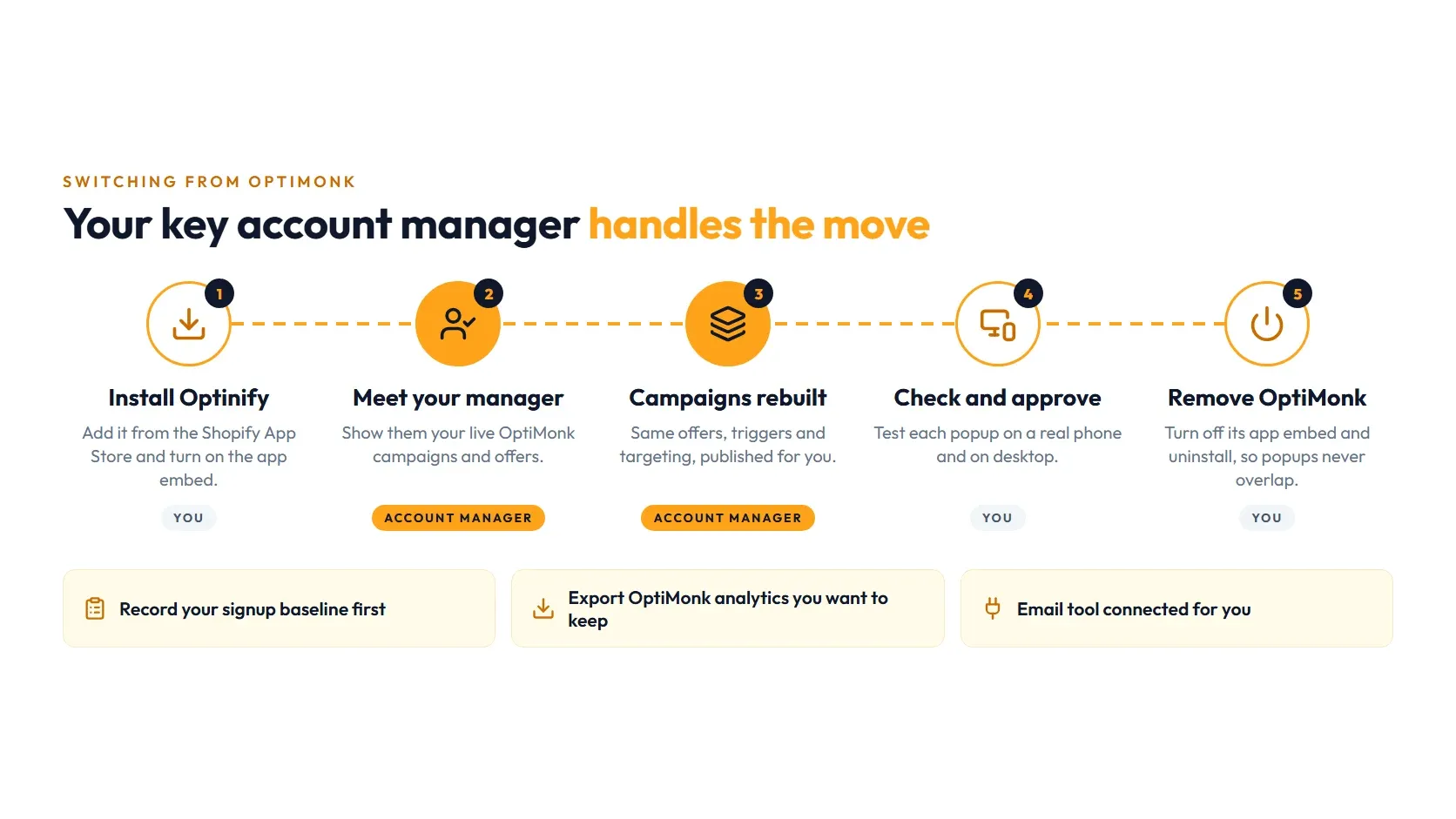
Nobody can honestly promise that switching lifts your conversion rate. There's no reliable public benchmark for it, and your offer matters more than your tool. What you can do when moving to an OptiMonk alternative is protect what's working.
- Record your baseline. Write down signup rate, revenue per campaign and new subscribers per week. Export anything you want to keep, since analytics history is unlikely to follow you.
- Move your best campaign first. Copy the offer, trigger and audience exactly. Change one thing and you won't know what made the difference.
- Check the handoff. Submit your own email, then confirm the contact reaches your email tool with the right tags, the discount code works and your welcome workflow fires. Most problems show up here.
- Compare conversion rates fairly. Run the new popup on part of your traffic or on alternate weeks, and never show two tools to the same visitor. Wait for a few hundred signups before you decide.
- Watch real sessions. Open it on a real phone, and use recordings to see whether the popup covers add-to-cart.
- Move the rest, then remove OptiMonk. Turn off its app embed and uninstall it, so old script doesn't stay on your store.
If you're moving to Optinify, your key account manager recreates your campaigns, matches the targeting, connects your email tool and publishes everything. Prefer to do it yourself? Check our step-by-step guide to adding a popup.
How We Picked These OptiMonk Alternatives
We started from the apps in our own roundup of Shopify popup apps, since we've already looked at each of them. An app made this list if it has a live Shopify App Store listing with published prices, and it either replaces OptiMonk's core job or does part of it well enough to matter. Each entry says which is which.
We read each listing and, where useful, the vendor's site on October 30, 2026, and we say so where they disagree. Conversion claims from vendors stayed out, ours included. Optinify ranks first because that's our call, and we'd rather you know that than pretend it's neutral.
Frequently Asked Questions About OptiMonk Alternatives
Try Optinify on Your Store
Optinify is the OptiMonk alternative we'd test first if you're a Shopify store on the Growth plan with around 20,000 visitors. You're paying for the jump to 100K pageviews. Optinify covers that traffic for $49, with every feature, real people on chat and a key account manager to move your campaigns.
Start your 14-day free trial, or book a demo if you'd like a walkthrough first.
Start your 14-day free trial · Human support · All features on every plan